|
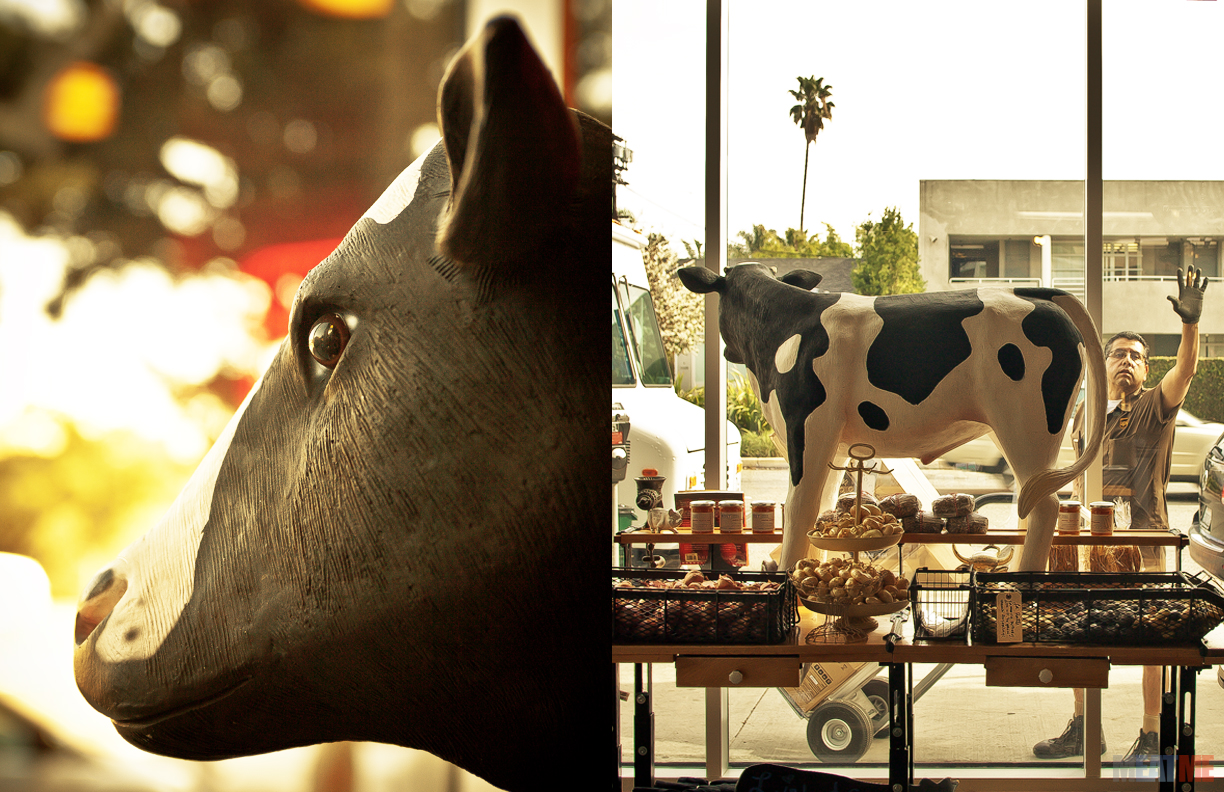
| UPS waives to be let in for its daily deliveries. |
MEAT ME: So how did Lindy & Grundy come to be?
Amelia: Those are our nicknames. I’m Lindy and Erika is Grundy. They are literally just our silly pet names that we have had for each other for many years. The names came to be when we had a few too many glasses of wine at Erika’s Mom’s house one winter in up state NY. We came up with the most nerdy, silly names that we could possibility dream up and it started with Grundy and we decided that Grundy needed a girlfriend. So I was almost Grundina but I became Lindy. I think Lindy is a little better than Grundina. Grundy & Grundina’s Meats would have been a little strange.
 |
| Amelia prepares the shop to be opened. The key is shaped like a 45 caliber pistol. |
MEAT ME: So when did you guys meet?
Erika: We met the fall of 2007. It was the week after I caught the bouquet at my best friends wedding. I was totally that grumpy person who was trying to fight it off and it landed on me. A week later I was back in New York, in Brooklyn. I was helping a friend out for an event and I was Dj’ing. I am not really a DJ but I have some good digs and Amelia was the girl behind the bar but she’s not really a bar tender.
Amelia: She turned and asked me for a white wine spritzer. I said what the hell is a white wine spritzer? The rest is history.
MEAT ME: What is the story behind the shop?
Amelia: It’s a big one.
 |
| Erika fills an order for the very first customer from behind the counter. |
Erika: Around the time Amelia and I got engaged it became very clear to both of us that as a codependent couple we are much more high performance when we are together. We have had very opposing jobs in terms of the scheduling. As a floral designer Amelia was getting up at three in the morning to go to her job designing floral displays for upscale hotels in New York City. I was just getting home at 2 in the morning from kitchen jobs and I realized how ridiculous that was for the both of us. We just never got to see each other.
Our interests are so similar and our sensibilities cross over so much. We really felt it was important to be in a family driven business. We decided to do something that was going to make sense for both of us. We actually went through a whole gamut of possibilities. The first idea was actually a flower/wine shop called “bottles and buds”! You see how far we have come? It really is amazing. It was going to be a flower shop in the front and I was going to sell wine and cheese in the back. But, I know as much about wine as the next person who is interested in food and beverage. So that idea went out the window.
 |
| They sell locally grown jams and potatoes. |
Amelia: Then we were thinking about doing an omelet shop.
Erika: I make a mean omelet. That has always been a fun idea as well. We started to talk about the idea of doing a general store or a market somewhere central in the community that is a place where people can come together, grow together, communicate, and bounce ideas off of each other. It’s a very old school concept of what is in the middle of the community. That idea grew into the butcher shop.
Shortly after that conversation I started butchering at a small market around the corner from our home in Brooklyn and I worked there for about 8 months before moving upstate with Amelia to go through a butcher apprenticeship program, then doing a consultation program with them that was about 8 to 10 months long that eventually became Lindy and Grundy.
During that whole process it became clear that LA was the spot to do this. There was just no real incredible butcher shop that is doing this nose to tail, sustainable, locally driven product. That’s always been really important to us; both from a political perspective as well as from a social perspective. The kind of people we like to surround ourselves with.
 |
| Amelia makes sure the display window are up to their standards. |
MEAT ME: Now you guys were vegans or vegetarians before you became butchers?
Amelia: I was a vegetarian for 14 years and Erika was for 7.
Erika: Can I just say though (not to talk about stereotypes so frequently) most lesbians are vegetarians (laughs). So that means that the dating pool becomes this narrow, vegetarian driven scene. Amelia was a vegetarian for 14 years I was for 7 years. I didn’t eat meat between the time I was in middle school up to mid college. Of course when you start dating vegetarians so frequently it’s even harder as a carnivore to want to justify eating meat especially if the person you’re dating is quiet militant about it. That was my experience for years. The last person I was with, before Amelia, who I was with for about 4 years was extremely hardcore vegetarian. Who would really give me a hard time if she ever saw me eating meat.
 |
| Amelia answers questions about specific type meat cuts. |
Amelia: Tell him about the closeted fried chicken eating habit in the woods!
Erika: So I am totally a self-identified closeted fried chicken eater- well, I used to be! So my ex was very militant and judgemental about it… Was always giving me a hard time.
I would get up every Sunday morning while this girl was still sleeping. I would say something like, “Hey sweetie I’m gonna go to the market and I’m gonna get stuff to make brunch.” So I would go to the market and I would get all the breakfast things I’m supposed to get and I would grab a box of crappy fried chicken (this in Ohio, before I had access to sustainably raised meats). I would drive into the woods and I would sit down and I would open this box of fried chicken (this is 9 in the morning) and I would devour it, savoring every bite! Then I would wash my hands, throw everything away discard of the evidence in a trash can. This went on for literally for about 3 years that I would not tell anybody about this fried chicken problem that I had. I was amazing!
Amelia: It’s amazing because she has mentioned this story in previous press that we’ve done. We have been in a lot of different magazines and gay magazines; and we know our ex-girlfriends read them and it’s funny that we were closeted fried chicken eaters and look now we have a butcher shop.
 |
| Erika wraps meat to go as Amelia places the proper labels with the specific types of meat. |
MEAT ME: When did you guys switch to MEAT?
Amelia: My body just started really craving animal protein. I wasn’t craving it, but my body was. I was really anemic, and I decided to respond to the needs of my body.The only answer for me,was to eat animal protein. On our first date I ate a carnitas taco. Look at me… Now I am the self procaliamed “Pork Princess!” I have come a long way.
Erika: What’s amazing is that on our first date I was actually exclaiming to her, “I can’t believe that I am on a date with a non vegetarian.” She’s sitting there eating all this pork. As I say this to her Amelia says, “Well actually, (as she takes a I am cool with that!” Whatever it is that you are going through I am ok with because you are eating meat.
That is partially the reason we do that Meat Market, it’s a singles mixer for people who eat MEAT.
 |
| Amelia stands on top of a stepping stool to tend to the customers. Dry aged steaks await the perfect customer. |
MEAT ME: What is this exactly it’s a “Meat Market”? I have no idea what this is.
Erika: Amelia and I… Mostly Amelia with the help of the shop; we throw a singles mixer driven towards carnivores. It’s based on that idea that it really sucks to go on a date, a blind date when you go out with a vegetarian when you’re not. How much fun is that?
Amelia: You shouldn’t have to feel guilty about what you are eating. It sucks because we have so many awesome single people that come into our shop and they’ll ask for one pork chop or one steak and I’ll say, “Just a steak for one? Are you single? Are you lookin’?” “Alright cause I got a girl for you!” I know she comes in every week for her pork chop too!
 |
| Amelia has a chef on staff to prepare good meat as she offers up a sample to a customer stopping by. |
MEAT ME: So do you pair people up based on the type of meat that they get?
Amelia: Not just that, but personalities. We get to know our regulars so well.
MEAT ME: That’s so awesome! You should have your own website, meatmatcher.com
Erika: That’s why on Valentine’s Day we cook for all the single people in our lives.
Amelia: This year, Erika cooked up a few big fat rib eyes,tons of veggies and our guests brought the wine. I set a full formal table setting- it was lovely.
 |
| Amelia and Manager Melissa talk about how much they love their chef. |
MEAT ME: What type of shop do you guys run?
Erika: We are a whole animal sustainable butcher shop. Our focus is on utilizing the whole carcass and sourcing our animals from small local family farms that raise all of their animals sustainably and organically. These farms may not be “certified organic” because they are so small that they cannot afford to have that kind of certification. We go to our farms all the time and we are very close friends with all of our ranchers. It’s almost like partnerships with them. We are growing together. We help each other. At the end of the day we are a sustainable whole animal butcher shop that focuses on the utilization of the entire carcass.
We don’t believe that there needs to be waste when you butcher animals. We make dog food, we make scrapple,rillettes,pate,chili,soups,stocks…we make it all.
 |
| Erika checks a list of spices as the rest of the shop is cutting meat. |
MEAT ME: So it’s organic, natural, grass fed?
Amelia: It’s a slippery slope when I hear terms like that. It’s not that simple.
Erika: Yea we get customers that come in and ask if everything in here is “certified organic”- we say, “No, definitely not.” The organic and health food industry has exploded so much in the past 10 years, along with it, has caused a lot of confusion and misunderstanding in the field.
So now you have people walking around saying they’ll only eat food if it is organic. Well do they really know where it came from? Do they really know that organic certification comes along with many, loopholes that are very expensive, and that it is really not designed for small family farms to succeed.
Amelia: I certainly feel like it’s a system designed for big Ag (agricultural market) to break into a new market.
 |
| One of their apprentice look for an organic spice. |
Erika: Many people are under the impression that by supporting organic they are supporting small family farms but in reality they do not realize that slow food means it’s going to cost you more, and its going to take a longer time. You have to be ok with that, and they are always shocked. “What do you mean I can’t have 25 pounds of short ribs?” Well guess what 25 pounds of short ribs is going to be one whole animal. Can we put that into perspective for a second? What does that mean for you? What does that mean for the rest of the world? How are we impacting the world by the way we consume? That really drives a lot of how we see things.
Amelia: We have rules at our shop. You can’t get more then 6 chicken breasts at a time, at our shop. Why? Because I only get 160 chickens a week from Rainbow Ranch Farms that is raising their chickens exclusively for my shop. 160 chickens. There is one full breast on a chicken that we split, debone, and take the skin off to make 2 filets of boneless skinless chicken breast. If someone wants to get that entire amount how many birds it that taking up? So how many birds have died because you only want to eat that one part of the bird? That’s disgusting. These are called first world problems. You don’t see this in other first world countries. This is a uniquely American problem. As consumers they are used to getting what they want, when they want it. Somebody raised this animal, somebody slaughtered this animal, somebody had to go pick up the animal from slaughter, somebody had to open up a butcher shop, somebody had to pay their employees to stand there and butcher chickens all morning so you can only eat your boneless skinless chicken breast. It makes no sense.
Erika: When you research terms like certified organic or human certified animal handling or natural. Even though it hasn’t been given antibiotics its entire life are you ok with the fact that it has been eating corn and soy that is genetically modified? Do you see where I am going with this?
 |
| Amelia slices up some meat for a customer. |
MEAT ME: Yes.
Erika: You have to pick and choose your own battles man. For us we are not willing to afford those battles, straight up. So we set our own standards.
Amelia: I am not twisting anybody’s arm to walk into my shop - People walk in because they want to. It is your choice if you want to spend more money, and in return get meat that is single origin and 100% traceable from local ranches.I pay more money for my animal’s wholesale than most people will pay retail at large grocery store chains.I’m paying wholesale, double or triple for what they can buy retail at a commercial shop. We have a very marginal mark up. Nobody is begging you to come into my shop; no body is twisting your arm. Once that chicken is bagged and tagged it is up to you as a consumer to decide if you want it or not and what matters to you.
 |
| Erika makes some sausage links. |
Erika: You get what you pay for. I had a gentleman customer come up to me and he was kind of joking and he and it was weird because I didn’t catch the joke. He says do you guys take EBT cards? Actually that is something that Amelia and I are very passionate about we don’t feel that eating clean food is something that is earned because your of the financial, or the tax bracket that can afford this. We wish that everybody could afford to eat this way.Just because you can’t afford it doesn’t me you should have to eat crap, and eat processed stuff. As I started to explain myself he kind of said, “Well I was just joking, but I just see this as a luxury item.” And I said, “That unfortunate that we have to call it that.”
Amelia: A lot of people shop with us, that I know, cannot afford to shop with us. We have a lot of regulars. They are coming here for clean traceable food. I always hook these people up. I give stuff away for free. All day, everyday I give stuff out for free because I see the need and it’s ok.
 |
| Dry aged steaks on display. Amelia chats with her friend and pig sitter. |
Erika: I gave away 2 bacon wrapped filets today for someone’s birthday. I am not making that money, but guess what she’s happy… You know?
Amelia: I’ll see a family come in and they’ll tell me what their whole budget is for food and I’ll throw in a whole chicken on the house or a couple pounds of ground beef because I know they can make that stretch. It’s important to support each other – they are coming and supporting my struggling business,so the least I can do is help them out where I can. That’s something that we are committed to, always. We are very thankful for the regulars that we have. Some people can buy a 2 or 3 inch porterhouse and not blink, most people can’t ever afford to get dry aged steaks. That’s why I call them special occasion steaks.
Erika: You shouldn’t eat a rib eye everyday.
Amelia: We guide folks to “everyday steaks” like London broils, sirloin tips, chicken steaks, and rancher steaks, all hand tenderized and if you need help I’ll give you directions.
Erika: Even if it is $18.99 a pound guess it’s small enough that your walking out still paying 5 bucks for a steak and you know what that’s ok. You are not loosing your shirt.
Amelia: People just have to think differently about the way they consume and not be ashamed that they can’t get a rib eye or a filet. Our rancher steak is incredible.
 |
| One of their apprentices wraps meat for a customer. |
MEAT ME: What is the deal with the dry aged meat?
Amelia: Well the process of dry aging meat is…
Erika: It’s interesting because along with ideas of preservation like charcuterie and dried cured meats. It comes from a similar origin people have learned to make something stretch especially when it is delightful and you are able to somehow heighten your senses by doing it. Like the difference between a PBR and a Guinness, it is going to be night and day. The process (there is some literature out there) is about keeping the meat in the ideal temperature and humidity level and the right air circulation around it. The idea is to continue to flip the meat every few days so that it gets the same kind of exposure to that circulation. Usually folks will say you want to keep the meat at about 41 degrees, 41 degrees because it is just cold enough, but its just warm enough. The health department will say everything has to be 41 degrees or under. So if you keep it at 41 degrees it is still very well refrigerated it is creating an environment that is ideal for a very lovely bacterial growth without it going totally haywire. So a lot of the bacteria that you will see in penicillin like a cheese or a brie (that’s the white funky stuff on the outside). There is a good bacteria and there is bad bacteria. Just like there is good mold and bad mold. So I am always checking in on it to make sure it is looking good, that it smells good. Every single dry aged item that I cut I will taste raw in my mouth while I am cutting in because that is what I owe to my customers. We are asking customers for $45 dollars a pound.
Erika: Customer’s see me tasting the raw meat in front of them and they will say stuff like “Woah! What are you doing?” I smell it and I am getting up close with the muscles. They’re asking, “Is it bad or something?” and I am like, “No, I trust this.” I know exactly what this is supposed to smell like. I can tell you how something taste by how it smells.
 |
| An apprentice cuts into a pig carcass. |
Amelia: The actual process of dry aging… Say a loin starts out about this big (shows me around 24 inches) during the dry age process its shrinking its loosing its moisture during that process and during the process the connective tissue breaks down, making the meat naturally more tender. Because the meat is loosing its moisture it has a more concentrated flavor that’s why dry aged meat is so different.
Erika: That is why it costs more. Lets be honest we are in the business of price per pound so for example, say I buy it at $3.50 per pound. I am cutting it down which makes the price go up and then it’s going to age. Its taking up real estate, its using up electricity, its taking up x, y, z, and that all cost something. By the time that happens it shrinks and it is suddenly lighter and we have to factor that in. That is basically why the price goes up so much. Typically I leave it at about 82 to 83 percent humidity in my walk-in which I think is nice for dry aging. You will find supportive literature that says yes, and that says no. There is a wide variety of information out there for that. You learn little tricks to make it your own, but what makes it harder for us as a result it leaves little room for curing and doing charcuterie in there. My main focus and my main moneymaker is the dry aging. In order to make everything else more available I can charge more for the dry aged and charge a little less on the other stuff. Kind of tit-for-tat.
 |
| Erika is in the walk in sawing meat off a carcass. |
MEAT ME: How many rules and regulations do you have to follow? How often do people come to check you out?
Amelia: We are inspected by the California Department of Food and Agriculture every week. Of course the local health department comes every couple of months unexpectedly. When we opened we had to get licensed by the California Department of Food and Agriculture as Meat and Poultry processing inspectors and we are only licensed to inspect the processing of our own animals. Whole carcasses come in, we inspect them we take their temperatures and we log the information on all the animals. We have to do the same thing for anything that is processed. We have to log anything that is smoked, cured. We have SSOP and HACP to follow.
Erika: SSOP is the sanitation operating procedures for opening and closing. So that means we come in, we inspect the whole place. We make sure everything is clean, that the band saw is working and not dull. These are the things that we go through several times a day to ensure the safety of our employees and our customers.
Amelia: We fall under a lot of regulation. We are inspected all the time. Our inspector said that we have the most immaculate meat processing facility in all of Southern California. She inspects every plant.
Ericka: You can smell that by walking in. If you ever smell bad meat, you ever walk into a butcher shop that doesn’t smell like ours, you know what’s happening. A lot of times that has to do with boxed meat. Boxed meat traps moisture inside of a container along with air so it is going to start to turn at a certain point. Along with the dry aged processes we are able to treat our meat with a specialized way that we can actually prolong its shelf life, be careful with it and before it even gets to that point we cut our losses. It’s either getting cooked, and or frozen and that’s how we preserve it and that’s why we have a frozen food section.
 |
| The walk-in is a very tight place to work in. |
MEAT ME: Do you find yourself struggling as a small butcher shop?
Erika: It’s unfortunately a system that is set up for failure and that is status quo. We talk about creating a resource to support our farmers to be able to bring their animals to slaughter and make money at it. You could be so lucky as to make money at it. It’s not like Amelia and I have gotten a paycheck since we have started.
Amelia: Not one.
Erika: Not even 25 cents. It’s not like that.
Amelia: People still complain about our prices. If you don’t want to pay the price for this quality meat then go shop elsewhere.There is always going to be someone who cares. It might even be that person that can’t even afford it. If they do eat meat they are going to come get it from my shop and support my business.
Erika: What is frustrating unfortunately is that here we are willing to give and give and give. We give out so much free stuff. Then there are the people that get used to that and start asking for shit. That’s when it really hurts, because guess what dude I am kind of late on my rent right now. I need what your about to give me and if you can’t give it to me. Why are you going to make me feel bad for saying, “Sorry no discount today.” Cause everybody has got that rainy day. It’s just not that simple, it’s just easy to get frustrated about it. It’s just not a perfect world.
 |
| Erika saws the carcass with precision. |
MEAT ME: Is there a way to tell when meat goes bad?
Erika: There is a lot of paranoia out there and its interesting to me because wether you get it today or in three days it is going to be the same product that I have in my shop. Unless it has been improperly stored or you have left it in your car on your dashboard when it’s hot out. You know what I am saying. Lets all follow the same rules to make sure meat stays fresh. If you are out meat shopping go right home dude and put in on fridge. Don’t leave it on your kitchen counter because I have no control over that. Once it walks out my door that’s that. There are 2 things I think people should look out for. Let’s be real for a second. When there is vacuum packing involved there is an odor that is created by vacuum packing. What happens is that poultry, especially, has the tendency to smell horrible when it is in a deoxygenated environment and a lot of people open it and think whoa, that’s bad, because we as humans trust our noses. I can take a fresh chicken that was slaughtered yesterday put it in a vacuum packed bag and open it 2 days later and it is going to smell horrible. It’s amazing. What I tell people is when you look at it is there a yellow sticky film, is it tacky. That is the first indicator. Second take it an rinse it off in cold water and pad it dry and set it out in the open air, let it breath for about 5 minutes take a big whiff. Doses it smell pretty knurly or is it ok? That smell has a tendency to dissipate. Third, cook it. While your cooking it does is smell awful? Does it small rancid because that’s your third indicator? If you cook it and it doesn’t smell delicious (cause all food should smell delicious while you are cooking) and even then if you smell it and it’s a little off it’s not going to do anything. You would not believe some of the bad stuff I have eaten just because I know what’s really good and really bad, and I have only been sick twice in my life.
Erika: I get phone calls from people who have had this for a day and call me and ask is this still ok? There are enzymes in the meat. There is life in there. Especially with the dry aged stuff it turns all black and its aged. When I cut into it, it blooms but it has a shorter life span. People associate color with freshness. In our shop we don’t use any pink salts or preservatives what so ever.
 |
| Erika carries 20 - 30 pound carcass out to the shop counter. |
MEAT ME: Even your sausages?
Erika: Nope. Nothing none of our curing, not even our bacon.
Amelia: If we make it, it will last about 7 days fresh. All of our stuff is done the way its been done forever. Do it the way you want to do, but we do it the way it has always been done. Rock salt, sugar and spices.
Erika: People come up to me and tell me its been 3 days and its already starting to lose color. Yeah that’s a good thing…we don’t pump our meat!
Erika: One of the first things that Amelia and I did was took a tour of the meat section of Walmart with one of the guys who we learned from and what he does is pick up every single package and takes you through the ingredients..
 |
| Meat is placed on the racks in their dry aging process. |
Amelia: Ingredients? Ingredients on meat?
Erika: Why should something that naturally exits have ingredients? That’s crazy.
Amelia: We don’t do that. We do everything the old fashion way. Even our spices are certified organic. Everything we do is organically done and fresh.
MEAT ME: Do you have to get the contents of your labels approved by the your inspector.
 |
| Amelia put on a pig nose to entertain the children that come to visit the shop. |
Amelia: Yes.
Erika: Primarily they are looking for legalities. We have to submit the recipes and they have to review it and then they ok it. They always do anyway. For example, say I have a spicy Italian sausage if it is spicy I am only allowed to put in a certain percentage or less of paprika or any kind of red colored ingredient for the fear that I may use grey or bad meat and dye it and make it bright red. You see what I am saying. That is the oldest trick in the book.
Amelia: A lot of pregnant women shop at Lindy and Grundy’s because we don’t add unnatural ingredients to our products.
Erika: You are what you eat. That’s what we think about when we choose not to add chemicals to our meat. We don’t even use processed sugars. We use brown sugar.
 |
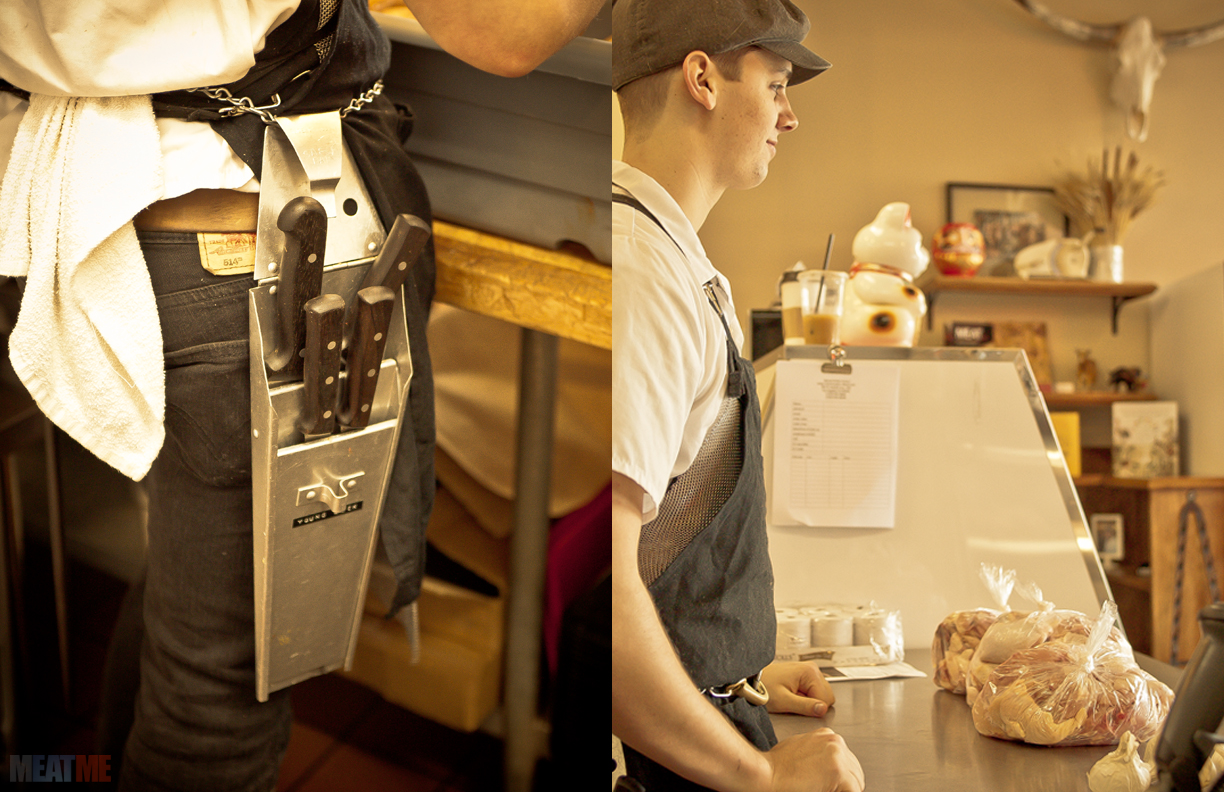
| You can see the words MEAT and LARD tattooed on Erika's knuckles. |
Amelia: I call what we use “hippy sugar”.
Erika: We use maple but we also use sucanat it is completely dehydrated cane juice. Sugar that is found in its rawest form. Which mean it doesn’t harm the environment in its distillation process. Which is very important to us. It is very flavorful. It has a slightly mapley flavor to it. We have found out that when a lot of things are processes a lot of its good stuff is taken out.
 |
| A piece of pork awaits to be butchered. |
MEAT ME: What is your individual specialties? What do you feel you are best at?
Amelia: I am great at the front of the house. I am great at preaching sustainability and talking about the farming practices of our ranchers; customer service and talking to people. We both trained as butchers, but quickly realized our strengths and weaknesses in the shop an where we were needed most. She can butcher faster and better than I can, and I need to be the one at the counter.
Erika: In a sense Amelia is the academic and I am the athlete. It’s kind of weird. Her background is in investigative journalism so it helped with the background of our ranches and the slaughterhouse. At a certain point there is a crossover. Amelia really cares about the appearance from the front of the house perspective, which also carries into sanitation.
 |
| Amelia informs a customer on the best way to smoke his pork shoulders. |
It’s crazy I have been everywhere, but how do you get the inside of your shop to look so good? Your display cases look like museum art.
Amelia: Well we are both artists and perfectionists and both of us oversee everything that goes into that case. From the placement of the rosemary, to the way its tied, to the way its trayed, to the way its sits next to anything in the case. This is what happens when girls open up a butcher shop everything is going to look pretty and clean.
Erika: If I see somebody tie a roast and one of the strings is slightly crooked I literally make them retie it and it’s not fun these kids are not happy to hear this stuff. At a certain point they are like if I don’t mess up they are not going to yell at me. It drives them.
 |
| Erika linking sausage. |
Amelia: It’s about constant sanitation, constant cleanliness, constant perfection. I will never be satisfied.
Erika: I don’t walk up to the case and see pieces of meat all over the place.
Amelia: I’ll walk up to the case and if I see a speck or smear of blood, I’ll be like, “Hey buddy clean that up. I want it to be pristine and perfect.” Changing the meat paper though out the day because its purging.
Erika: It’s hard because not everybody is going to notice. We’ll walk in with the shop already being open and we’ll be like, “What is that? Why is that? That should have been pulled!” Like having a beautiful ham out on a Tuesday. What special occasion is someone gonna buy a whole ham for? Get it out of there!
 |
| An apprentice awaits instruction on how to cut the pork. |
MEAT ME: Do you ever have any leftovers?
Amelia: There are no leftovers. We utilize everything. We have a hot food section. Potpies, soups, meatballs, pâtés, riéts, and dog food. Pigskins.
Erika: There is a small about of waste. Because of our dry aged process we might have something that hangs for a week and if we have something that we don’t feel is fit for consuming we will cut that off and throw it away. There are those things, but we pride ourselves on only throwing away 10 to 15 pounds a day. We have to report that all to the CDFA. Normal from a yield perspective your going to be throwing away 20 to 30 percent of the animal so we are still way ahead of the game. Our inspectors see that and note it.
Say I have a pork chop in there and its about 3 days old and it starts to gray well guess what I can debone it and still roast the bone for stock and I can take what ever meat that I debone and it gets ground up for sausage. The whole idea is to be a couple steps a head of your self so nothing goes to waste.
 |
| Erika shows her apprentice how to hold his knife when making a special cut. |
MEAT ME: What are some challenges you guys face as women in a male dominated industry?
Amelia: Where do I even begin? Aside from the fact that we are women… We are gay women. So it’s different.
Erika: And we are really young.
Amelia: So you could take the 2 other women that you have profiled; the fact that they are not gay is to their benefit. We work in a blue-collar industry. Erika and I do not come form blue-collar backgrounds. I am 29 she is 31, we are married to each other, we are covered in tattoos and we are from Los Angeles. I am not a farmer. I am not coming into this from a family business, it is different. They will always get treated differently than we do. It’s different. I wear red lipstick everyday and Erika my wife has MEAT and LARD tattooed on her knuckles. We work with slaughterhouses in Modesto. We work with Republican Cowboys who look at us like, “What the hell are you doing here?” I am looking at their rail system telling them, “Yea, I got the same one in my shop… Yea, I butcher whole carcasses too!” I am actually a lot like you than you could ever know. So there is that aspect where we had to earn our respect in a completely different way; not just because we are woman, but because we are queer women. That was a lot harder than just being a straight woman who is born into this.
 |
| There is always something to be butchered at Lindy and Grundy's. |
Erika: There is the average thing where folks come in. Mostly men. Where they don’t’ look to us to ask questions, they look to Alex who 20 years old and my first apprentice and he is a dude and he’s big. They don’t look to ask us.
Amelia: Occasionally they’ll look at us, and they automatically gender us of course. “So who owns this place?” they ask and I go, “I do!” and they’ll say, “Oh.” (in surprise) They will look around for my husband and I’m like, “Yeah, me and my wife Erika.” They are like, “Ohhhh alright!” So I ask, “Alright now that your over that… do you want some meat?Come on buddy, what are you here for?”
Erika: Unfortunately it’s very typical that when people start to realize that we are gay and that we are woman that there is this weird gendering process that happens. They automatically want to make Amelia the girlie girl and me like some big butch person. I am not some big butch person I am more like a gay man. If you want to get down to it I am more like a twinkie little gay man.
 |
| An employee wears a hat stating what team he is representing. |
Amelia: I am the one they want to worry about. I wear the pants. Our regulars know that
Erika: For the same reason that she hires people and I fire people. There is a dynamic that happens and we’re comfortable with it. Even thought it has taken a long time. We have mostly men that work for us, other than Melissa and she’s the general manager, and it’s hard even for our own employees not to look at us as hysterical, unreasonable women. It’s the biggest stereotype in the world. I feel I have no choice but to fly off the handle just to be heard and its unfortunate to have that extra aggression that it takes just to get that point across. It takes so much energy and it’s exhausting.
MEAT ME: What type of recommendations would you give a young gay woman who is interested in opening up her own butcher shop?
Erika: You have to start by having some tact and some level of forgiveness. Always. You can’t expect people to get it right from the beginning. Stay strong about it and know exactly who you are. When you start into it never give yourself up. You’re going to second guess yourself a million and a half times.
Amelia: For me it is not about me, my gender, my sexuality, or me. It’s about something that is bigger than me, bigger than Erika, bigger than you, bigger than Lindy and Grundy. Its like we are food activist. I am not in this to sit around and make no money and not have a paycheck. I am in this because of my political passion to help and support local agriculture and keep it alive. Without butcher shops like us, with out the customers that come and support us everyday all those small farmers would not be able to exists. They are struggling. So if we don’t, as a society take risks like this and help educate people about how to consume consciously there will be not farms like this. The federal government is making it impossible for them to survive. Most ranchers have day jobs too. It used to not be that way. So whenever I feel like someone is coming into my shop and being sexist, homophobic, or if I see some ignorant comment on Yelp, I have to realize that this is bigger than me and that it’s bigger that these people that don’t get it. It is about the movement and that’s what I have to realize. I get plenty of people that are rude to me and need to be kicked out of my shop. Sometimes I just bite my lip. Give them their London Broil and let them go. Its not personal its not about me. It is bigger than us and we are honored to be apart of a small change in our own community.
 |
| Every item in the shop has its special place. |
MEAT ME: What is your absolute favorite meat?
Amelia: Pork butt skin on bone in. That’s me. My favorite animal protein is pork. I could go the rest of my life without eating any other animal proteins as long as I have pork I am fine. I love pork, all things pork. I am the pork princess. Particularly I love the shoulder of any animal. I am someone who is gonna prefer a pot roast over a rib eye. I like fatty braised cut. I like something that is cooked low and slow and pulled and shredded. That’s me, pork but, bone in, skin on.
Erika: I am all about the tiny little secrets. I wanna live right in here where it is perfectly fatty and marbled and beautiful. The thing is I almost have a hard time choosing beef, pork, lamb and chicken. I am especially partial to beef because there are more cuts, more variety. I have a personal relationship with anything that I cut. There is glory in each of these cuts. There is a drastic different process to each cut and how you do it means everything. When we talk about my absolute favorites its the things that make our shop special. Our shoulder blade steak, not to be confused with the scotch tender or the flat iron, I am talking about this tiny little sliver of a muscle that holds the chuck roast to the inside of the shoulder blade. Usually it gets ground up you don’t see that anywhere. Love the velvet steak its the back of the hamstring its so tender you don’t even have to tenderize it. These things are everything to me because it is such a little surprise and it is so beautiful to me.
 |
| Amelia waits on customers while Erika cuts meat with the table saw. |
MEAT ME: What is one of the greatest honors in your life? I heard you got to go to the White House?
Amelia: I thought I was going to have a heart attack.
I remember I answered the phone. It was this really busy day. She was like, “Hi my name is Emily and I am calling with Our Time from Washington DC we are partnering with the White House for this Initiative for Americans to support young entrepreneurs we have chosen you guys as one of the top 100 entrepreneurs in the United States under 30 years old.” I thought it was a scam. I said you do know that you are calling a butcher shop in Los Angeles right? She goes, “Yea Amelia we know all about you guys and your journey. We are so proud of you and we want you to come to DC.” I was like oh my God. We had our publicist call and check it out and it was legit. Then they said we would like you guys to be one of the 3 panelists to sit and address the chamber of commerce. CNN was there and the whole thing.
Erika: They actually choose us out of all of those people to open up the whole event. We were going to write a big speech but we just decided that we wanted to wing it because we are off the cuff type of people.
Amelia: One of the most proud moments was for me to sit at the chamber of commerce and on national TV say, “I’m Amelia Posada I am 29 years old this is my wife Erika Nakamura she is 31 and together we own the only sustainable organic butcher shop in the state of California, we get whole carcass and we only support local agriculture.”
Erika: It was literally within two weeks of DC legalizing gay marriage, it was an impact.
Amelia: Many people came up to us afterwards and they said, “In the history of the Chamber of Commerce nobody has ever said those words.”
 |
| Lindy & Grundy Meats |